

AI Boosting Productivity but Fueling Job Anxiety Among Canadian Workers
Hiring managers and job seekers say AI is boosting efficiency and helping close skills gaps, but fears are rising around workforce cuts and fewer entry-level roles
TORONTO, June 10, 2026 (GLOBE NEWSWIRE) -- AI is helping businesses work faster and close skills gaps, but according to a new Express Employment Professionals-Harris Poll survey, those gains are also deepening worker unease about hiring and the future of work.
AI Is Already Reshaping the Workplace
AI is making an impact, with 63% of Canadian hiring managers saying their company uses AI in the workplace, while 53% of employed Canadian job seekers report the same about their own company.
For hiring managers, that growing use is closely tied to business value:
- 50% say AI could help address the shortage of skilled talent, and 63% say integrating AI tools could be essential to bridging the widening skills gap seen in new hires.
- 67% say generative AI is expected to improve efficiency, 65% say it will free up employee time and 52% say it will enhance customer service.
Those benefits are already showing up in day-to-day work. Hiring managers most often say AI has led to higher company productivity (24%), provided employees with more resources to improve their skills (23%), boosted creativity (22%) and resulted in improved employee productivity (22%).
Among companies that use AI, 79% of hiring managers say the personal connection between employees and clients remains unaffected.
But Unease Is Growing Alongside It
Yet those benefits are arriving alongside a growing sense of unease.
Almost all job seekers (94%) say they have concerns about the growing use of AI in the workplace, while 55% of hiring managers say AI-driven automation threatens to diminish their company’s brand personality.
Among job seekers, the biggest worries center on how AI could weaken both effort and opportunity over time:
- 49% worry there will be an overdependence on technology, while 45% say employees will put in less effort in favor of AI completing the work.
- 40% fear there will be fewer entry-level jobs for workers to gain experience, while many are concerned employees will lose their ability to think creatively (49%) or to problem solve (42%).
That tension is not limited to workers alone. Two-thirds of hiring managers (66%) believe employees are concerned that generative AI will make them useless, underscoring how quickly the conversation can shift from productivity gains to anxiety about long-term value at work.
When Efficiency Starts to Threaten Headcount
The tension becomes more concrete when the conversation shifts from productivity to jobs. Half of hiring managers (49%) say AI could allow their company to reduce its workforce by needing fewer workers, while 78% of job seekers say they are scared companies will not need to hire as much because of it.
That concern is showing up in workforce plans, with 23% of hiring managers planning to decrease or hold headcount steady in 2026 saying AI solutions are the reason, up from 14% last year. Among job seekers whose company uses AI, 75% say they are scared their own workforce could be reduced as well.
Entry-Level Work Faces Some of the Earliest Pressure
For many workers, the pressure feels especially intense at the start of the career ladder. Job seekers say AI is already changing the kind of early experience that has traditionally helped people get a foot in the door, build skills and move forward.
Entry-level work is a major pressure point:
- 44% of job seekers say they know of companies using AI to automate tasks handled by entry-level employees.
- 41% agree it is more efficient to use AI for entry-level tasks than to hire and train a candidate.
There Is Optimism, but Not Equal Confidence
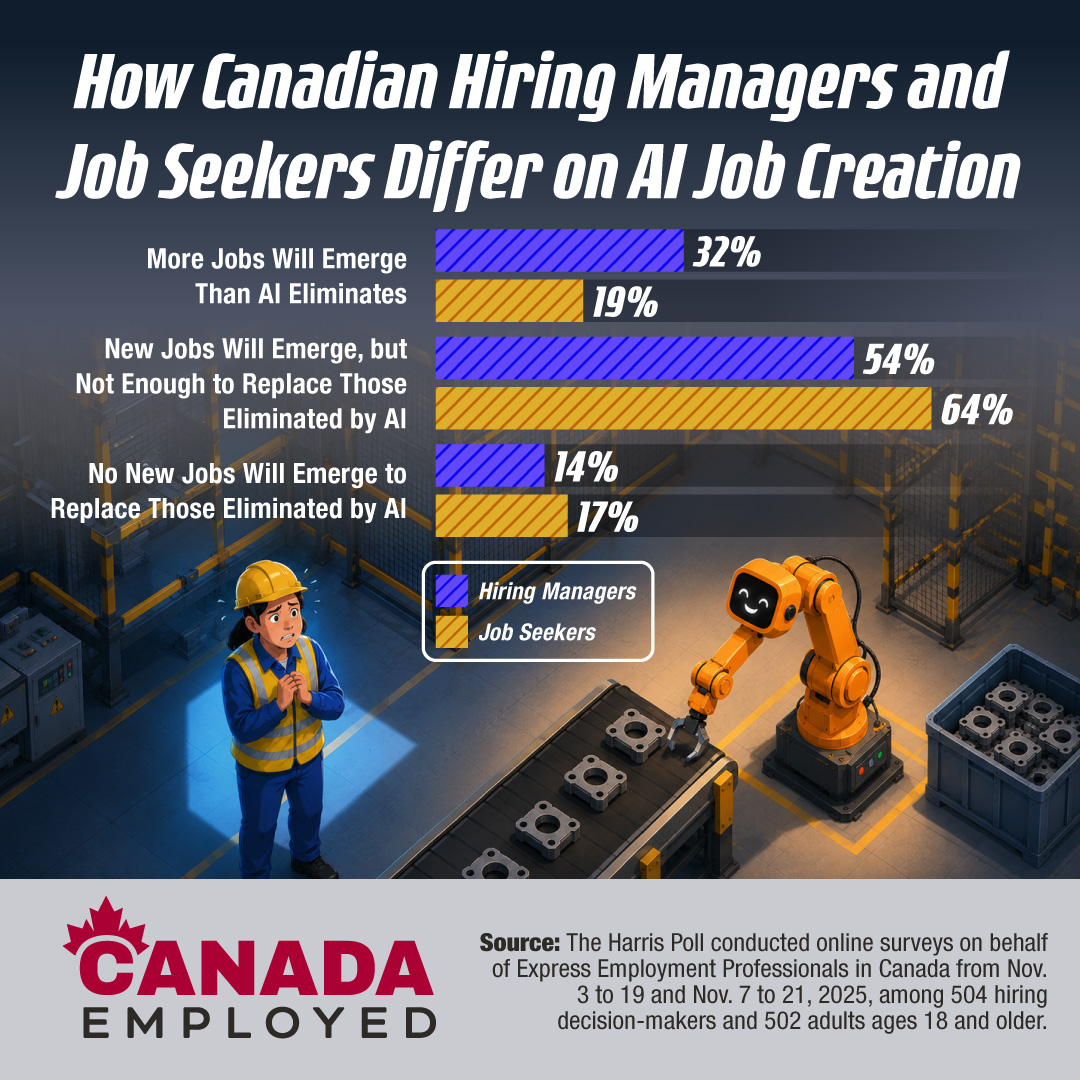
Even with the disruption, most hiring managers (76%) and job seekers (74%) believe new jobs will emerge to compensate for roles eliminated by AI.
But job seekers are far less confident those new roles will be enough:
- Only 13% of job seekers believe more new jobs will emerge than the number of jobs eliminated.
- 37% expect some new jobs will emerge, but not enough to replace those lost.
- 24% expect only a few limited jobs to emerge.
- 26% expect no new jobs to emerge to replace those eliminated.
The More Hopeful Path Depends on How AI Is Used
Even amid ongoing change, the data points to a more constructive path forward. Many hiring managers still see AI as a tool for helping people work better, not simply as a way to cut labour. That more hopeful outlook depends on whether businesses invest in training and prepare workers to use AI alongside the skills technology cannot replace.
Many say that starts with better preparation:
- 38% of hiring managers say companies should provide on-the-job training specific to managing and working alongside AI.
- 38% say businesses should offer dedicated training for skills that are not replaceable with AI.
- 24% point to apprenticeship and internship programs that include AI training.
“The future of work will be shaped by how businesses empower people to work alongside AI,” said Bob Funk Jr., CEO, president and chairman of Express Employment International. “In an economy as incredibly diverse as Canada’s, the real opportunity is to pair innovation with training, adaptability and human potential so the workforce becomes stronger, more prepared and more confident about what comes next.”
Discover more research and real-world workforce trends from the Canada Employed series at ExpressPros.ca/Newsroom.
Survey Methodology
The Job Insights survey was conducted online within Canada by The Harris Poll on behalf of Express Employment Professionals from Nov. 3 to 19, 2025, among 504 Canadian hiring decision-makers.
The Job Seeker Report was conducted online within Canada by The Harris Poll on behalf of Express Employment Professionals from Nov. 7 to 21, 2025, among 502 adults ages 18 and older.
For full survey methodology, please contact Ana Curic at Ana@MapleLeafStrategies.com.
If you would like to arrange for an interview to discuss this topic, please contact Ana Curic at
(613) 858-2622 or email Ana@MapleLeafStrategies.com.
About Robert (Bob) Funk Jr.
Robert (Bob) Funk Jr. is the Chief Executive Officer, President and Chairman of Express Employment International, a global staffing franchisor founded and headquartered in Oklahoma City, Oklahoma. He leads a portfolio of workforce solution brands, including the flagship Express Employment Professionals franchise, along with several affiliated brands serving specialized markets. The Express franchise brand is an industry-leading, international staffing company with franchise locations across the U.S., Canada, South Africa, Australia and New Zealand.
About Express Employment Professionals
At Express Employment Professionals, we’re in the business of people. From job seekers to client companies, Express helps people thrive and businesses grow. Our international network of franchises offers localized staffing solutions to the communities they serve across the U.S., Canada, South Africa, Australia and New Zealand, employing more than 11 million people globally since its inception. For more information, visit ExpressPros.ca.
A photo accompanying this announcement is available at https://www.globenewswire.com/NewsRoom/AttachmentNg/9c7e5fa8-50cc-4d7b-89f1-0717d108d2e2


AI Job Creation
AI Job Creation
Legal Disclaimer:
EIN Presswire provides this news content "as is" without warranty of any kind. We do not accept any responsibility or liability for the accuracy, content, images, videos, licenses, completeness, legality, or reliability of the information contained in this article. If you have any complaints or copyright issues related to this article, kindly contact the author above.
